

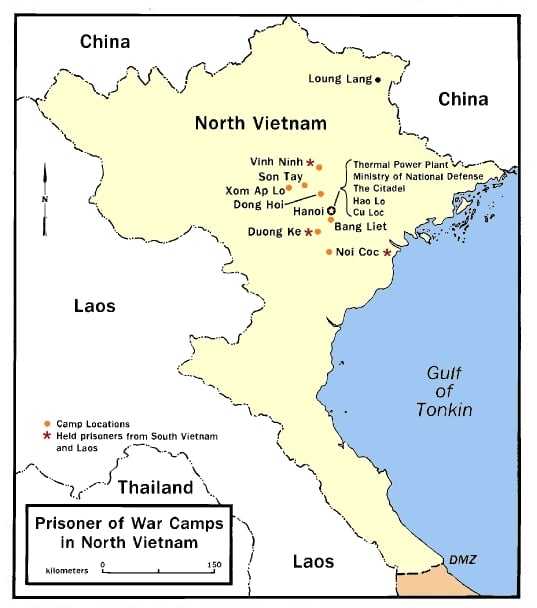
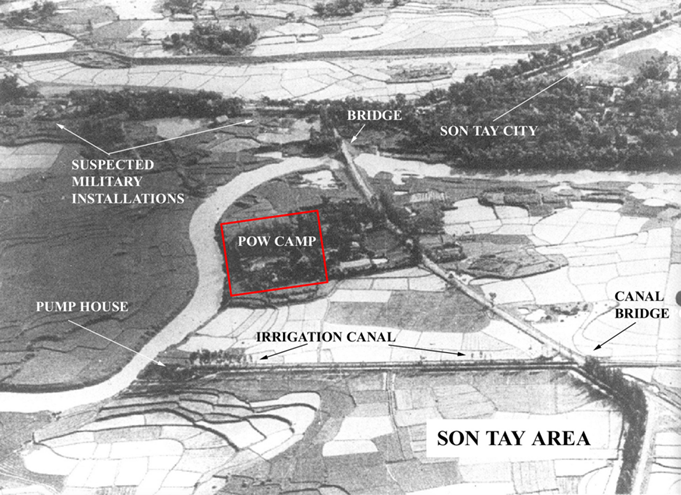
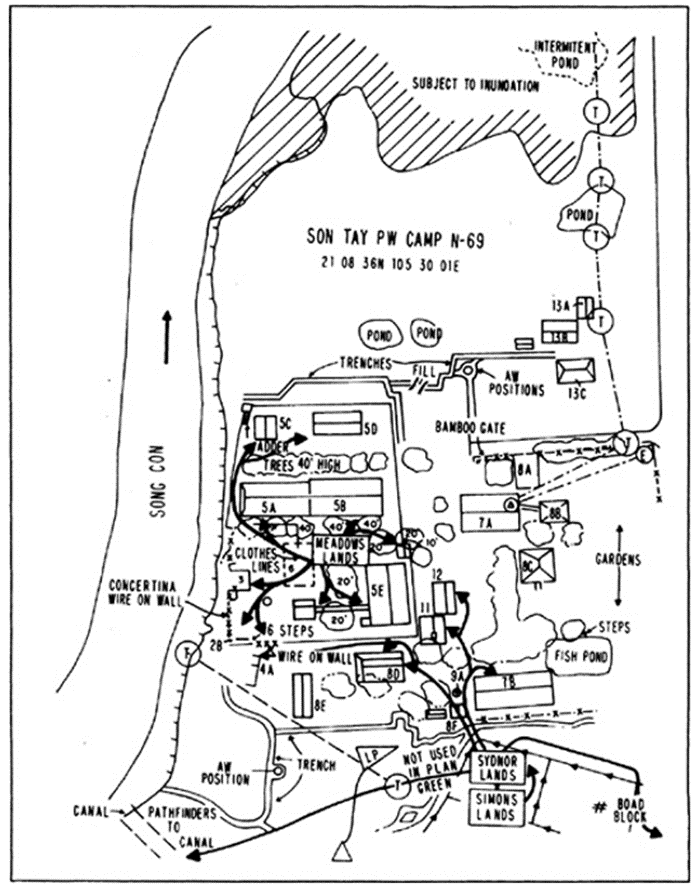
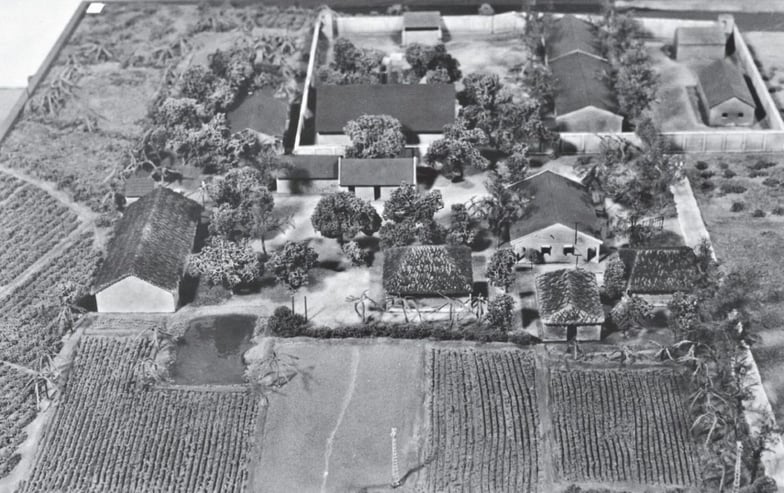
The ‘Barbara’ model of the Son Tay complex, built by the CIA, presents a view of the fields that would be used for the landing zone and, at the top on the banks of the river, the POW compound. Photo credit: USAF/NATIONAL ARCHIVES. Caption: Defensemedianetwork.com (Named for Barbara L. Strosnider, who worked in the office that created her at the DIA.)
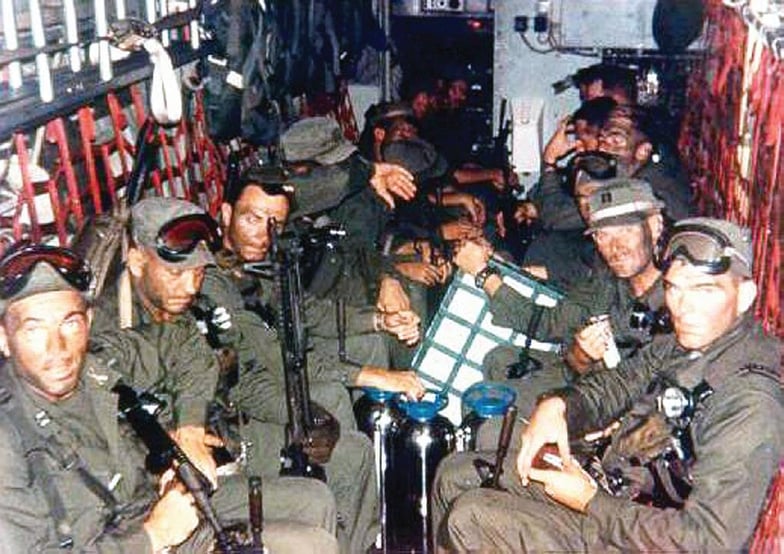
Ci-dessous : Blueboy raiders on the way to Son Tay inside HH-3 Banana 1. Sitting on the left from front: Capt. Dick Meadows, Master Sgt. Galen Kittleson, Sgt. John Lippert. On the right from front: Sgt. Patrick St. Clair, Capt. Dan McKinney, Staff Sgt. Kenneth McMullen, Staff Sgt. Charles Erickson, Sgt. 1st Class William Tapley, and Capt. Thomas Jaeger. Photo credit: U.S. AIR FORCE PHOTOGRAPH. Caption: Defensemedianetwork.com
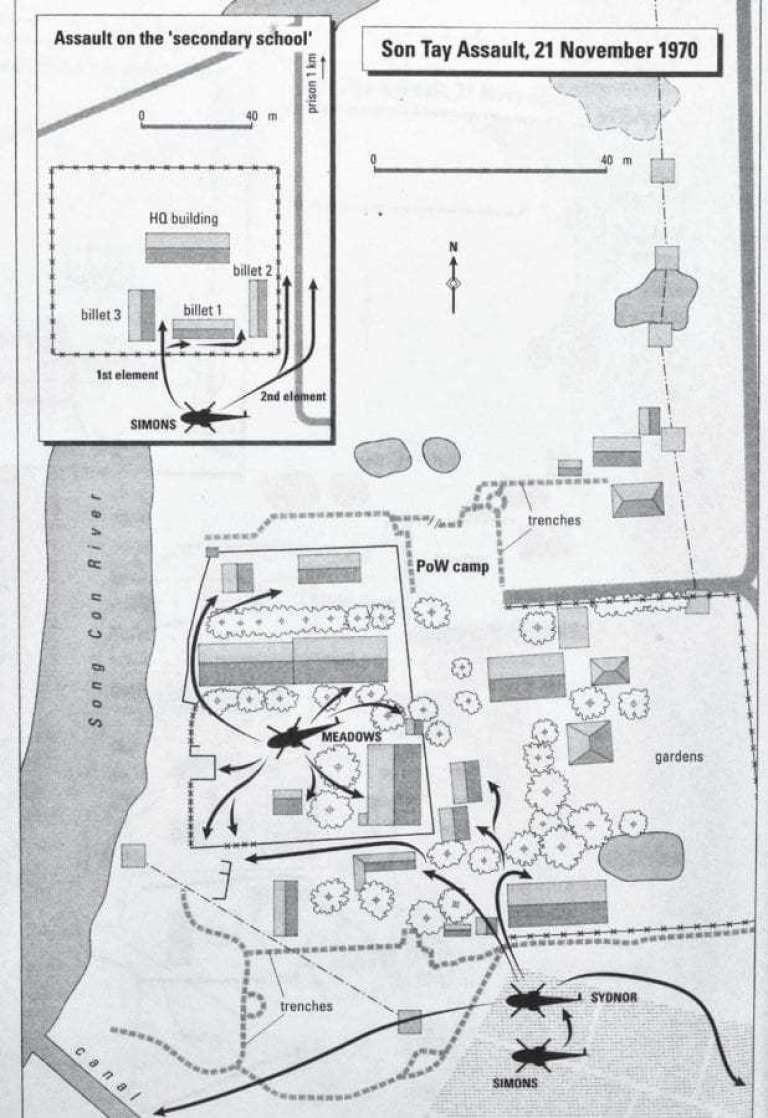
Map of movements during the Son Tay assault. Image credit: MAP FROM ‘LEAVE NO MAN BEHIND’, COPYRIGHT DAVID ISBY. Caption: Defensemedianetwork.com
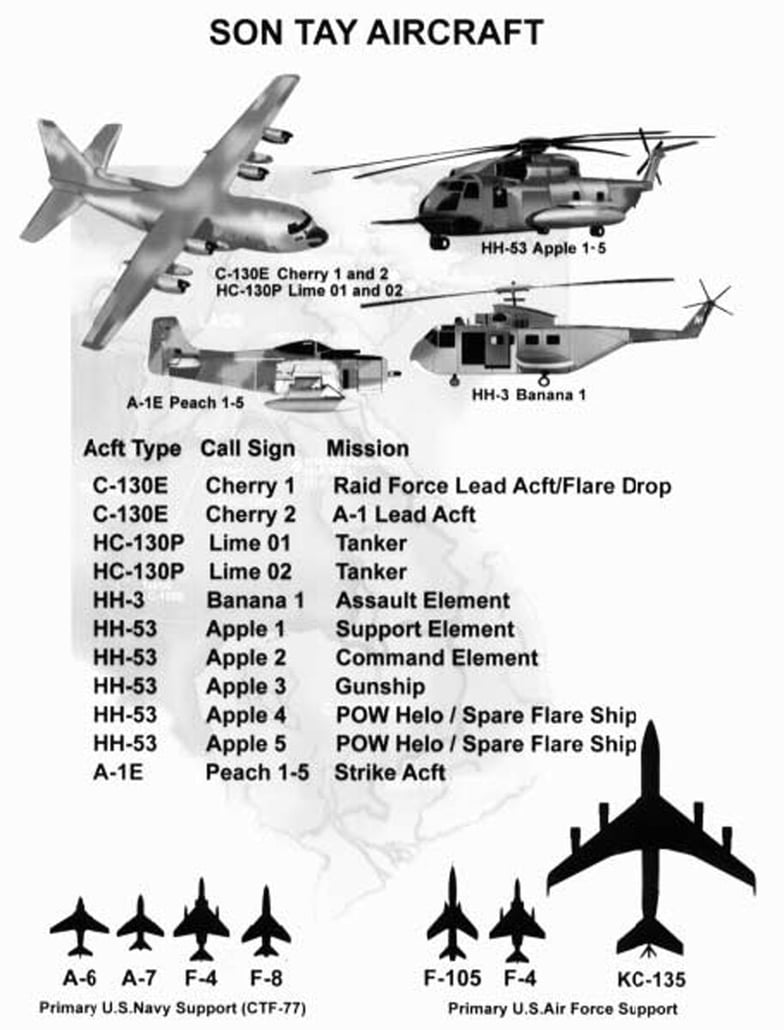
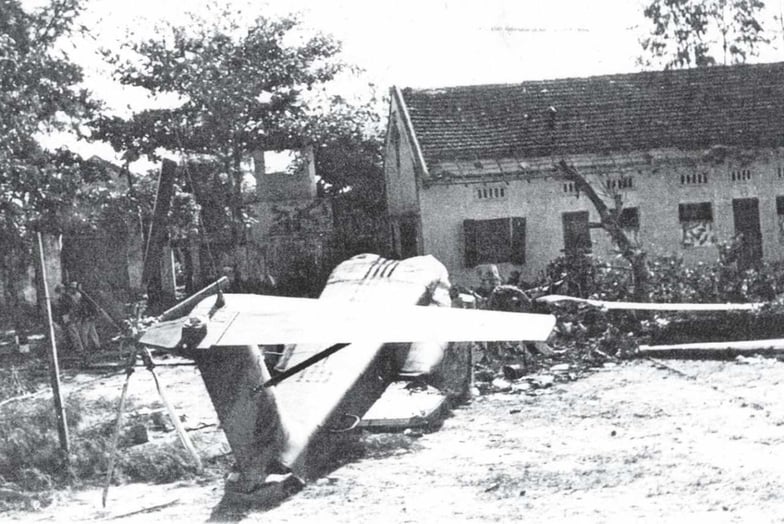
The remains of Banana 1, destroyed by the raiders as they departed the prison camp. Photo credit: U.S. AIR FORCE PHOTO. Caption: Defensemedianetwork.com
In daylight, a CH-53C approaches an HC-130P tanker to refuel. In the Son Tay raid, this challenging maneuver was done at night and at low altitude, in radio silence and without lights. Photo credit: USAF/NATIONAL ARCHIVES. Caption: Defensemedianetwork.com
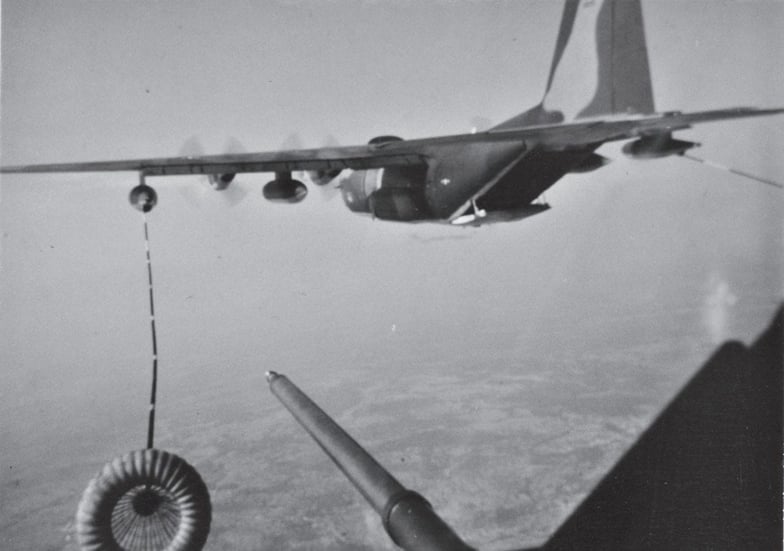
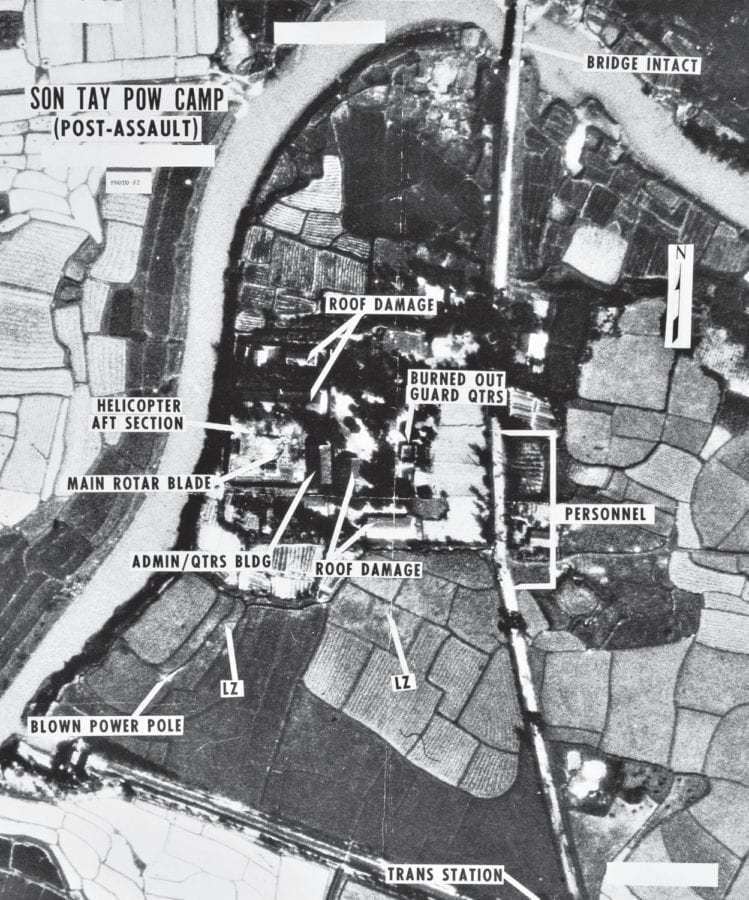
Photo post assaut
Afin de bien saisir l’histoire du raid, je me permets de citer le blog ci-dessous et de reproduire le texte qui détaille l’opération.
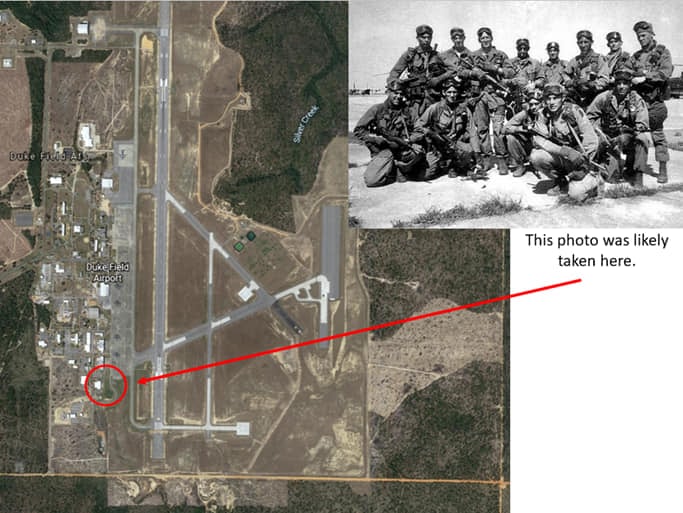
“By 1970 the US had been directly involved in the Vietnam War for over a decade and a half with no end in sight. In the US, opposition to the war was at an all time high and the polarization of the issue was literally tearing the country apart. Richard Nixon had won the US Presidential election in 1968 on the back of promising to end the draft, restore law and order, and bring about an “honorable end” to the war in Vietnam. However, that promised “honorable end” still looked like a distant dream though by the spring of 1970 – even though Henry Kissinger, US Secretary of State, had already begun having secret meetings in Paris with high level representatives of the North Vietnamese government. Meanwhile, the treatment and fate of U.S. prisoners of war in Vietnam had also become a subject of widespread concern in the United States. The vast majority of these POWs were Navy, Air Force, and Marine Corps flying officers, and it was widely known that the North Vietnamese were subjecting them to torture, malnutrition, and inhumane living conditions. The goal of the North Vietnamese was not to extract useful military intelligence, it was simply to break their spirit and to coerce them into making statements condemning the US and praising the North Vietnamese. Their aim was to use such propaganda to sew dissent and demoralization among the US ranks and to influence the civilian population even further in political opposition to the war. Against this turbulent backdrop, the US military had identified and located numerous prison camps in North Vietnamese territory where US POWs were being held. Beginning in May 1970 the concept of planning for a POW rescue operation got underway, when extensive analysis of Air Force aerial photographs identified a North Vietnamese prison camp near Sơn Tây that appeared to hold approximately 60-65 Americans – several of whom seemed to be in need of urgent medical care. Planning was authorized by the Joint Chiefs of Staff and was undertaken jointly by Air Force Brigadier General LeRoy J. Manor and Army Colonel Arthur D. “Bull” Simons – under the codename “Operation Ivory Coast”. Gen. Manor set up a training facility at Eglin’s Duke Field and brought together his planning staff, while Col. Simons recruited personnel from the 6th and 7th Special Forces Groups at Fort Bragg, North Carolina. In all, 103 Army and 116 Air Force personnel were selected, including ground force members, aircrew, support groups, and planners – the task force planned, trained, and operated under the title of the “Joint Contingency Task Group” (JCTG). Planning took place throughout the month of August 1970, while air and ground training began in early September. Ground training for the mission was carried out at a remote range on featuring a complete, full-size replica of the prison compound, and a detailed five-foot-by-five-foot scale table model. During the month of October extensive, several full-scale dress rehearsals – some involving live firing – took place involving all air and ground elements of the planned mission, running from start to finish. One of the key outcomes of such detailed training and rehearsing was the realization that the ubiquitous UH-1 “Huey” helicopter was not up the task and the larger HH-53 “Jolly Green Giant” was selected for the mission instead. The Special Forces ground element was organized into three platoons: a 14-man assault group (codenamed Blueboy); a 22-man immediate support group (codenamed Greenleaf), and a 20-man perimeter security / backup group (codenamed Redwine). These 56 raiders were heavily armed with CAR-15 carbines, M16 rifles, M79 grenade launchers, shotguns, M60 machine guns, Claymore mines, demolition charges, and hand grenades. They were also equipped with a wide range of additional tools and equipment including wire and bolt cutters, axes, chainsaws, crowbars, ropes, bullhorns, and lights to assist with freeing and marshaling the POWs for rescue. The ground force was also equipped for voice communications with UHF and VHF radios, as well as an individual survival radio for each man. The formal launch order for the mission was given at 15:56 local time 20 November 1970, and at 02:19 hours local time on 21 November 1970 the HH-3E helicopter (callsign ‘Banana’) carrying the Blueboy assault force landed in the courtyard of the Son Tay prison complex. The assault force debussed from their helicopter, immediately fanned out into 4 elements and began an aggressive attack on the prison – killing every guard they happened upon, while also rapidly but methodically searching every cell block for prisoners. After two thorough searches of the camp, the raiders determined that there were in fact no prisoners being held there at that time and the extraction command was passed through to the waiting HH-53 helicopters. The assault force and two support elements were all back onboard, accounted for, and in the air by 02:48 hours – less than half an hour after the assault force had landed. By 03:15 they had cleared North Vietnamese territory and by 04:28 they were back on the ground at Udorn AFB in Thailand. Although the Son Tay raid was considered a militarily tactical success from a planning, training and execution perspective, it was resoundingly condemned as a failure, an embarrassment and an endangerment to the treatment of American POWs by Nixon’s political opponents, and by the Vietnam War protest movement. Even within the military, it was widely seen as an intelligence failure. Information had been received from a usually reliable North Vietnamese source on 19 November that the Son Tay prisoners had been moved to a different camp on the 14th of July – due to the wells at Son Tay becoming contaminated from flooding in the area. However, due to the compartmentalization in which intelligence was analyzed, processed, and shared this information did not become known to the senior commanders in Washington D.C. until only a few hours before the mission was due to launch. As there was no confirmation of this 4-month old information from a single source, the decision was taken to proceed as planned. While the raid failed to free any POWs, it did have several positive implications for American POWs. The most immediate result was a massive improvement in the morale of the POWs knowing that the US government was actively attempting to rescue and repatriate them. On the North Vietnamese side the effect was immediate as well – American prisoners in North Vietnam were all moved to Hỏa Lò Prison in downtown Hanoi. For the first time in months, many of the prisoners now had cell mates to talk to, they were allowed extra recreational activities, and food, medical care, and mail delivery all improved after the raid too. This great improvement in their conditions led the Americans to nickname the prison “The Hanoi Hilton”. On 27 January 1973 President Nixon signed the Paris Peace Accords, establishing a cease-fire with North Vietnam and officially ending direct US military involvement in the Vietnam War. From February through April 1973 the North Vietnamese released 591 acknowledged US prisoners of war during “Operation Homecoming” – although controversy has continued ever since as to whether the North Vietnamese accurately accounted for all American POWs, and also whether they did in fact repatriate them all. Despite the tatical success of the mission, and its planning and training, no effort was made to institutionally preserve the experience and lessons learned by command task force, nor its procedures for enabling national level command authority over high value operations. The willingness – if not eagerness to sweep aside the memory of the operation was perhaps due to the bitter and lingering criticisms of it.
It would take a second major national embarrassment and military failure at a remote desert site in Iran 10 years later – as well as issues with operations in Grenada in 1983, Panama in 1989, and Somalia in 1993 – before a unified U.S. Special Operations Command would be established and fully capable to plan, train, and execute joint special operations across the world. A process that ultimately paid dividends when Osama Bin Laden, architect of the 9/11 attacks on New York City and Pentagon, was tracked to and eradicated from his hideaway deep inside Pakistan on 2 May 2011”.
Voici le lien d’un autre blog permettant de comprendre l’opération.
The November 21st, 1970, raid on the POW camp at Son Tay, North Vietnam. A panel of Raiders and a POW who was at the Son Tay POW camp. John Gargus (Raider, MC-130 navigator/planner), Terry Buckler (Raider, Green Beret), Patrick St.Clair (Raider, Green Beret), Lee Ellis (POW, USAF F-4 pilot). Presented in Texas Tech University's annual Vietnam War conference, April 10th, 2021. Moderated by Cliff Westbrook (son of Clyde "Neal" Westbrook, aircraft commander of HC-130 Lime 02 on the raid.)
Five members of the Association presented the Son Tay Raid at Texas Tech University on Saturday, April 10th, 2021.
John Gargus
Terry Buckler
Pat St.Clair
Lee Ellis
Cliff Westbrook
In the audience were representatives of universities in the UK, Poland, Australia, Vietnam, and all across the US. This Texas Tech University symposium is an annual event for historians, professors, authors, veterans, and politicians with all viewpoints of America's involvement in Vietnam, and is open to the public.
Our virtual presentation lasted an hour and a half and the title is taken from a quote of POW, Admiral, and US Senator Jeremiah Denton: "The Greatest Thing that Happened in the Vietnam War."
________________________________________________________________________________________
Countdown to the Half-Century Reunion.
The Son Tay Raid in the Airborne Command Post:
Listening to every transmission from 35,000 feet
Episode 1.
It’s 8pm. We arrive on station above international waters of the Gulf of Tonkin. We are a 30-man team equipped with top secret technologies that allow us to see, hear and detect every transmission of voice, radio, code, and radar in North Vietnam. It’s Friday night, November 20th, 1970. The sun set more than two hours ago and we welcome the protection, stealth, and clarity of this darkness. We need to focus.
We are listeners, an overwatch, sentinels spying on our enemy from a Boeing RC-135M, which resembles the Boeing 707. Our dark-lit workspace spans two-thirds of the arching width of the fuselage. The other third is a partitioned aisle way running the entire length of the port side. That allows pilots, navigators, and others without a need-to-know to pass by without disturbing our work. (All have Top Secret clearances, but not all have a need-to-know.) At two places along the fuselage, we have a doorway to that aisle. From the appearance of our battle station, long and narrow, surrounded by metal, plastic, and colored displays, one might imagine us lurking thousands of feet below Mean Sea Level rather than above.
Aboard our aircraft are USAF Colonel Norman Frisbie and Lt Col Bill Robinson, an Army Green Beret. Both these gentlemen, we had never met before...
This is Episode 1 of a fresh, new telling of the story of The Son Tay Raid from a new vantage point. Read the rest of Episode 1 at...
https://thesontayraid.com/?p=464
Countdown to the Half-Century Reunion.
The Son Tay Raid in the Airborne Command Post:
Listening to every transmission from 35,000 feet
Episode 2.
Aboard our aircraft are USAF Colonel Norman Frisbie and Lt Col Bill Robinson, an Army Green Beret. Both these gentlemen, we had never met before. This was most unusual. Our missions are Top Secret, Code Word. We can’t even acknowledge to people what level of code word our missions are—literally, even the code word itself is classified. These guests must be special.
For this mission, we knew something was up even at Okinawa, pre-flight. Our pre-mission crew rest was not normal—it was out of synch and to me it felt like a surprise. The crews that were assembled for the pre-mission briefing were not our normal crew combinations—in fact, there were two RC-135Ms being pre-flighted and launched, a primary and a backup. This was an indication to all that something really significant was going to happen tonight...
Read the rest of Episode 2 at...
https://thesontayraid.com/?p=469
This is Episode 2 of a fresh, new telling of the story of The Son Tay Raid from a new vantage point.
Countdown to the Half-Century Reunion.
The Son Tay Raid in the Airborne Command Post:
Listening to every transmission from 35,000 feet
Episode 3.
At 8:45pm, Brig Gen Manor arrives at the Monkey Mountain Command Post and establishes secure, encrypted communications links with us. The Green Berets and their aircrews arrive at Udorn Royal Thai Air Force Base (RTAFB) to board their mission helicopters and C-130s, all prepped and readied by their maintenance crews.
Also ready to launch:
F-105s and EC-121s at Korat RTAFB
F-4s at Udorn RTAFB
KC-135s at U-Tapao RTAFB
A-1Es at Nakhon Phanom RTAFB
MC-130s at Takhli RTAFB
General Manor and these soldiers and the mission commanders and many of the pilots and navigators for these aircrews had been secretly holed up at the CIA compound at Takhli for the past few days in anticipation of President Nixon’s launch order, which came through yesterday.
There is nothing unusual at this time. I focus on my two screens, black CRTs (cathode ray tubes) with green sine waves. My controls are dials, knobs, buttons, rollers, and switches. The modular units before me are functioning well and, in case of equipment failure, they can immediately be swapped out by the AMTs (Airborne Maintenance Technicians). We are in peak condition.
At 10:25, the MC-130 Cherry 2 takes off from Takhli RTAFB headed to rendezvous with the A-1Es from Nakhon Phanom RTAFB.
At 11:05, the Navy’s EP-3 “Big Look” aircraft arrives on station over the Gulf of Tonkin for electronic warfare during the massive diversionary raid on Haiphong harbor that the Navy will be providing just prior to the Son Tay Raid.
At 11:17, a formation of two HC-130s (Lime 1 and Lime 2) and six helicopters (“Banana” and Apple 1 thru Apple 5) are departing Udorn RTAFB with the 56 Green Berets who will...
Read the rest of Episode 3 at...
https://thesontayraid.com/?p=471
This is Episode 3 of a fresh, new telling of the story of The Son Tay Raid from a new vantage point.
Countdown to the Half-Century Reunion.
The Son Tay Raid in the Airborne Command Post:
Listening to every transmission from 35,000 feet
Episode 4.
At 12:35am, the first problem arises. Frog 1 has to abort due to a broken oil line. Frog 1 is an EC-121 “College Eye” aircraft orbiting over the Gulf of Tonkin like us. It is based on the “Constellation” airliner and has a role similar to today’s E-3 AWACS (Airborne Warning and Control System). Its role is to shine a radar on all aircraft in North Vietnam—especially on our low-flying assault force tonight, which would be too low for our land- and sea-based radars to follow. In contrast, our RC-135’s role is to monitor every radio wave that the enemy transmits.
As a testament to the excellence in planning, there is a backup aircraft, Frog 2, already on station nearby. Literally, within one minute, Frog 2 takes over that role.
At 12:40, at only 1,000 feet above the ground as observed by Frog 2 and according to plan, the six helicopters begin air refueling along their path over Laos with their HC-130 tankers Lime 1 and Lime 2. In this unprecedented formation are the one HH-3 Jolly Green Giant and five...
Read the rest of Episode 4 at...
https://thesontayraid.com/?p=474
This is Episode 4 of a fresh, new telling of the story of The Son Tay Raid from a new vantage point.
Countdown to the Half-Century Reunion.
The Son Tay Raid in the Airborne Command Post:
Listening to every transmission from 35,000 feet
Episode 5.
Our RC-135M is for Signal Intelligence (SIGINT) and, particularly, Communications Intelligence (COMINT). It is designed to intercept virtually anything transmitted into the airwaves, from taxi cabs to tanks, walkie-talkies to facsimile, Morse code to radar signals, tactical airfield communications with aircraft (TACAIR) to Anti-Aircraft Artillery (AAA) and SAM sites.
Behind the “front end” crew’s cockpit is a compartment fully decked out as an electronics workshop manned by the two Airborne Maintenance Technicians.
Then comes the main compartment filled with COMINT linguistic technicians. I’m at the front, on the other side of the wall from the AMTs.
Next you come to the 7-Op, the TACAIR operator. The job here is to monitor the enemy’s air activity. Each North Vietnamese airfield has its radio frequencies used by their Air Traffic Controllers to communicate with their aircraft and pilots. We are so personally familiar with these controllers and pilots that there are many of them that we recognize by their voice alone, even before anyone states the individual’s call sign. Often, we know the name of the pilot, where his home station is and what type of aircraft he is qualified in, and we glean a little about his personality.
This three hours during which the helicopters are flying from Udorn to Son Tay must seem extremely long for a helicopter, but we are used to this—and we are busy this entire time...
Read the rest of Episode 5 at...
https://thesontayraid.com/?p=479
Countdown to the Half-Century Reunion.
The Son Tay Raid in the Airborne Command Post:
Listening to every transmission from 35,000 feet
Episode 6.
At 1am, the battle begins. A swarm lights up our screens.
A massive, lethal armada of aircraft is launched by the Navy.
The carriers USS Hancock, Ranger, and Oriskany had staged seven A-3 tankers and electronic countermeasure aircraft at Da Nang AB. All seven now head up the coast to North Vietnam.
From the USS Oriskany: Twenty-five aircraft launch, including an E-1B, eighteen A-7s, and six F-8s.
From the USS Ranger: Twenty-six aircraft launch, including an E-1B, ten A-6s, nine A-7s, and six F-4s.
The NVAF Air Defense Command immediately has startled to life. They’re entirely surprised, confused, and slow to comprehend the...
Read the rest of Episode 6 at...
https://thesontayraid.com/?p=489
This is Episode 6 of a fresh, new telling of the story of The Son Tay Raid from a new vantage point.
Countdown to the Half-Century Reunion.
The Son Tay Raid in the Airborne Command Post:
Listening to every transmission from 35,000 feet
Episode 7.
The SA-2 system has six missiles circling a command building, typically spaced about 100 yards apart (see it on the website link below). They are mobile but are often in fixed positions and we know most of their locations ahead of time. Most of them are around Hanoi and Haiphong.
1:30am. The first flight of six Navy A-7 strike aircraft head into North Vietnam’s territorial waters straight toward industrial targets in the northern parts of Haiphong. Even at this point, the NVAF Command and Control System is only just now getting their wits about them, reaching a level of organization to muster a coordinated defense.
The Spoon Rest operator, tracking them, then alerts the acquisition radar operator. This acquisition radar is referred to as “Fan Song.” This Fan Song radar now locks on to a target...
Read the rest of Episode 7 at...
https://thesontayraid.com/?p=496
This is Episode 7 of a fresh, new telling of the story of The Son Tay Raid from a new vantage point.
Countdown to the Half-Century Reunion.
The Son Tay Raid in the Airborne Command Post:
Listening to every transmission from 35,000 feet
Episode 8.
Colonel Frisbie plugs his headset into my station to listen in.
I roll onto a promising signal. I hear a radar operator in the SAM site van start tracking a target.
We hear, in a clear voice, something like: “Xuất hiện tốp không một, phủỏng vị không chín không, cụ ly bốn mủỏi.”
Translation: “Bogey #1 has appeared, azimuth/bearing 090, range 40 kilometers”.
I press my microphone’s button and report this to my AMS. He reports it on the appropriate frequencies, but I’m too busy to listen to what he does with it.
This hapless NVAF SAM controller has no idea that every word he is saying is immediately being translated and broadcast in English to his executioner, an...
Read the rest of Episode 8 at...
https://thesontayraid.com/?p=501
This is Episode 8 of a fresh, new telling of the story of The Son Tay Raid from a new vantage point.
Countdown to the Half-Century Reunion.
The Son Tay Raid in the Airborne Command Post:
Listening to every transmission from 35,000 feet
Episode 9.
I press the RECORD button. I steal a glance up at my station’s large reel-to-reel tape, directly over my two central screens. They’re rolling, alright. I quickly refocus my eyes to determine who their bogey is—which blip on my screen. There are several of these Navy aircraft that he could be talking about. He certainly sees quite a few.
Our Navy bogeys are now over Haiphong harbor, within the Fan Song radar’s range. The tempo really picks up.
I hear the SAM control officer call out...
Read the rest of Episode 9 at...
https://thesontayraid.com/?p=509
This is Episode 9 of a fresh, new telling of the story of The Son Tay Raid from a new vantage point.
Countdown to the Half-Century Reunion.
The Son Tay Raid in the Airborne Command Post:
Listening to every transmission from 35,000 feet
Episode 10.
I hear the SAM control officer loudly issue the terminal command: “Phóng!” (Launch!)
Immediately, I hear the actual sound of the SAM missile blasting off—so good is our spy technology aboard our Hognose beauty! Under these circumstances, Hognose is what sexy looks like! The command to launch was clear and then one hell of a roaring sound as the SA-2 missile ignited its huge first stage rocket and took off.
This is the first SAM launch of the night. It’s 1:45am. All SAM activity is in the east, over Haiphong Harbor.
At this moment, far from this launch, the Son Tay Raid assault formation is now...
Read the rest of Episode 10 at...
https://thesontayraid.com/?p=513
This is Episode 10 of a fresh, new telling of the story of The Son Tay Raid from a new vantage point.
Countdown to the Half-Century Reunion.
The Son Tay Raid in the Airborne Command Post:
Listening to every transmission from 35,000 feet
Episode 11.
These Navy aircraft swarm toward Haiphong harbor over the next hour and a half, a continuous beeline of America’s top naval strike aircraft concentrating their menace on the enemy’s most important harbor.
[NOTE: History records that this 59-aircraft diversionary strike turns out to be the largest nighttime Naval operation to this point in the war. There had not been a night carrier operation this large since June of 1944, the Battle of the Philippine Sea, 26 years prior.]
I’m constantly scanning, rolling my dial, searching. The dial is excellent for fine-tuning. It’s like a miniature of one of those steering wheels that have a knob so that a city bus driver can drive with one hand. Clockwise takes me through the next few frequencies up.
2:08am. We hear the five USAF F-105 “Wild Weasel” aircraft arrive over Son Tay, each with their two SAM-site-killing Shrike missiles. This relatively small formation has snuck in from the west, while all the NVAF Air Defense Command has their focus on Haiphong in the east. The F-105s establish a taunting orbit, just daring a SAM site to lock on to them. They are looking for the Fan Song radars. If a Fan Song shines on them, the F-105 will pounce. It’s the epitome of a wild west duel: Weapons loaded and cocked, aimed right at each other. The SAMs and AAA are daring the F-105s to come in on them. The F-105s are daring the Fan Song radar to activate.
2:18am. “Alpha, Alpha, Alpha!” is broadcast by Cherry 1, the MC-130 announcing H-Hour of the Son Tay Raid as they have just released their 2 million candlepower Mk 24 flares over the Son Tay POW camp. The helicopters then land, their 56 Green Berets storming...
Read the rest of Episode 11 at...
https://thesontayraid.com/?p=516
Countdown to the Half-Century Reunion.
The Son Tay Raid in the Airborne Command Post:
Listening to every transmission from 35,000 feet
Episode 12.
2:30am. “Pull back by the normal plan” is broadcast by Lt Colonel Sydnor to begin withdrawing all troops from the Son Tay POW camp. The HH-53 helicopters Apple 1 and Apple 2 are called back in to extract the Green Berets.
2:31am. The F-105s launch the first two Shrikes against the four active Fan Song sites near Son Tay. Within the next six minutes, there are seven active Fan Song radars identified: four are at the Red River and three more are slightly north of that. Four of these seven are “hot” at any given moment.
If not for my headphones, the sound inside the RC-135M cabin is the same sound we all know from commercial flights. But when I’m tuned in to a SAM site and we’ve cleaned up the signals electronically strong and clear, I’m right inside the enemy’s control van, even knowing the number of people by their different voices. I picture that it’s probably dimmed lighting, like our cabin, with operators at their workstations. Their dark screens are lit up with bogeys, a rotating radar sweeping around their screen. The launch control officer is much like our AMS, professional, yet still having a personality, growing in excitement as their prey approached closer and closer to their claws…
Early in the war, the NVAF could shine on our aircraft and track all they want with impunity, launching their missiles at the optimum time, tracking for results and even launching again right away. Later, however, the Americans developed...
Read the rest of Episode 12 at...
https://thesontayraid.com/?p=521
This is Episode 12 (of 20 episodes) of a fresh, new telling of the story of The Son Tay Raid from a new vantage point.
Countdown to the Half-Century Reunion.
The Son Tay Raid in the Airborne Command Post:
Listening to every transmission from 35,000 feet
Episode 13.
The North Vietnamese Air Force are forced to turn on their radars sparingly and only at great risk to themselves.
2:35am. SAM launch! The first one in the Son Tay area tonight.
All operators on our RC-135M are pumped up, coordinating with each other, critically aware of the situation and reporting the real time intelligence intended to save American lives and eliminate the enemy threat.
I cannot believe my ears. I tune in to SAM site after SAM site and hear frenzied Vietnamese commands to track an aircraft here or lock on to a threatening fighter there. I’m passing details of SAM site coordinates, operators’ conversations, and potential launch preparations.
Allow me to patch in some additional details (pieced together from my conversations with of friends of mine in our Son Tay Raid Association who lived it) that I was not aware of in the heat of the battle.
At this moment, Firebird 5, an F-105 at 20,000 feet...
Read the rest of Episode 13 at...
https://thesontayraid.com/?p=525
This is Episode 13 of a fresh, new telling of the story of The Son Tay Raid from a new vantage point.
The weapons of choice: An SA-2 Surface-to-Air Missile second stage rocket with its warhead. A 100-lb "Willie Pete" White Phosphorus bomb. The CAR-15 with Singlepoint sight
Countdown to the Half-Century Reunion.
The Son Tay Raid in the Airborne Command Post:
Listening to every transmission from 35,000 feet
Episode 14.
Now, for guys in the F-105G, the SAM battle is also right beneath you in the Son Tay area.
Firebird 1, 2, 3, and 4, using roughly perpendicular inbound tracks, take turns launching on the radar signals of live SAM sites. Multiple SAMs are launching at them. In the night, a flying SA-2 looks like a telephone pole balanced on a reddish orange fireball oscillating as its gimbals respond to the radio telemetry signals.
A little perspective: Out of the hundreds of combat missions flown by the crewmembers in tonight’s mission, for almost all of them, this was the first time ever to have a SAM actually launch on them.
2:37am. Apple 1 begins re-boarding the first two groups of Green Berets just outside the Son Tay POW camp walls for exfiltration.
2:40am. Apple 1 departs the Son Tay POW camp with more than half the Green Berets.
Also at 2:40am: As Firebird 3 turns away from a target at 12,000 feet, a SAM launches. If the SAM is not moving in your windscreen, that’s when you know it’s headed for you. From Firebird 5’s vantage above, the huge explosion fireball seems to engulf Firebird 3, but then he hears, “Mayday, Mayday. Firebird 3 is hit...”
Read the rest of Episode 14 (of 20 episodes) at...
https://thesontayraid.com/?p=528
This is Episode 14 of a fresh, new telling of the story of The Son Tay Raid from a new vantage point.
Countdown to the Half-Century Reunion.
The Son Tay Raid in the Airborne Command Post:
Listening to every transmission from 35,000 feet
Episode 15.
Firebird 5 is now ordered into the fight. Capt Ted Lowry (EWO) knows Maj Don Kilgus (his pilot) as a man with an extremely aggressive heart. Having flown about 300 hours together, Lowry trusts him implicitly—Lowry says it works best that way, since Lowry is, by definition, 39 inches in trail at all times. Within seconds of entering the fight, Firebird 5 lines up on one of a number of SAM sites that were beginning to become very active.
The scope tells Lowry the location of a SAM site. Smart F-4 crews overhead know to put that on their 6 o’clock. Kilgus and Lowry turn to put it at their 12, straight ahead. At about 13 miles out, with the F-105’s state-of-the-art avionics system for their Shrike missile, Lowry acquires the target emitter. Get within the parameters. Raise the nose 25 degrees for optimal launch. Bleed the speed to 350 knots. Ready to fire.
The Shrike launches from under the right wing of the F-105. Kilgus executes an evasive 180 degree turn.
The electronic warfare suite gives the F-105’s crew a rattlesnake sound to let you know the SAM site is tracking you. When it changes, adding a steady tone, you know they’ve launched on you.
At that very moment, a rattlesnake and steady tone comes over your headphones: a SAM has launched on you...
Read the rest of Episode 15 at...
https://thesontayraid.com/?p=534
This is Episode 15 (of 20) of a fresh, new telling of the story of The Son Tay
Raid from a new vantage point.
Countdown to the Half-Century Reunion.
The Son Tay Raid in the Airborne Command Post:
Listening to every transmission from 35,000 feet
Episode 16.
2:47am: When the rattlesnake comes over the headphones, Lowry identifies the “High PRF” (Pulsed Repetition Frequency) signal and Firebird 5 turns inbound again to line up on it. Pull up 25 degrees. Launch. Hard left. The Shrike hits the bullseye. At $7,000 per Shrike, that’s a great investment.
No missiles left. Damaged by an SA-2. Time to turn southwest and limp to the nearest friendly base, right? No, they remain on station in orbit. You see, Kilgus and Lowry know they’ve shot all their Shrike missiles. But Charlie, sitting in a surviving SA-2 site, DOESN’T know that. Charlie sees the F-105G’s radar signature, so he’s going to think twice before he shines a radar on any more American aircraft tonight.
2:55am: When Brigham (the call sign of the Ground Controlled Intercept operators at Udorn RTAFB) announces that all other US aircraft have left the area, Firebird 1 tells his wingmen, “Firebirds egress,” Kilgus updates his status: “Firebird 5 is hit. We’re losing fuel and we need a tanker to head this way.” Kilgus says to Lowry, “Ted we don’t have enough...
Read the rest of Episode 16 (and see a video of SAMs and the F-105G) at...
https://thesontayraid.com/?p=537
Countdown to the Half-Century Reunion.
The Son Tay Raid in the Airborne Command Post:
Listening to every transmission from 35,000 feet
Episode 17.
As a proof of the absolute success of the plan, I don’t ever hear the North Vietnamese command authorities explicitly reference the assault force aircraft, neither helicopters nor C-130s. I only hear references to tracking and launching against the higher altitude aircraft, the fighters.
I must admit I am recording (contrary to our mission briefing instructions) many of the launches—for the guys on the ground who will never experience such a thing—but I keep up with every bit of my raid-focused scanning as instructed. At least 36 SAMs were launched tonight, an unprecedented amount.
As a trained and experienced TACAIR 7-Op, I’m also keeping an eye on the 7-Op channels. I see no MiG activity this whole evening. Our RC-135 even broadcasts an advisory that there is no MiG activity. On our 7-Op scans, we would have heard radio transmissions from any airfield tower, from the fighter pilots themselves, and would have heard bearing and range information broadcast from the Air Intercept Controllers.
Tonight, I would have heard any communication from the SAM or AAA sites to the North Vietnamese MiG fighters on alert at their bases. For instance, SAM and AAA sites would be notified to stand down if their own NVAF aircraft were planned to transit their area. If I hear this sort of thing, I’ll notify the 7-Op to look for enemy aircraft launched. I would also have heard the SAM and AAA sites being notified of any NVAF “friendly” fighters accidentally straying near their sector.
So, we are surprised when suddenly “MiG!!!”...
Read the rest of Episode 17 (of 20) at...
https://thesontayraid.com/?p=541
Countdown to the Half-Century Reunion.
The Son Tay Raid in the Airborne Command Post:
Listening to every transmission from 35,000 feet
Episode 18.
Of the 36 SAMs launched against US aircraft this night, two met their marks, F-105Gs, both. No American lives were lost. One F-105 limped back to base in Thailand with its battle damage. As you heard, the other F-105 that was hit made it to Laos before it became unflyable. The two crewmembers ejected safely and were rescued at dawn.
* * *
When all the excitement is over and things begin to settle down on the airwaves, we are briefed about the “negative items” message. It’s definitive: No POWs were found.
What an emotional let-down.
On the way back to Kadena AB on Okinawa, I vow to myself that I will get on the next Combat Apple mission to the Gulf of Tonkin. I want to intercept the North Vietnamese Air Defense Command’s daily reports of air activity from all sectors to their central headquarters. I know that it will be their assessment of what took place. We (the US Department of Defense) use that information to craft the wording of our press releases depending on how much the North Vietnamese government knows or doesn’t know at that point.
We land a little after sunrise at Kadena.
I succeed in getting on the next Gulf Bird even though I don’t have proper crew rest. My good buddy and fellow Vietnamese linguist Bruce McClelland does the same thing. He too is chomping at the bit to help intercept the North Vietnamese After-Action Reports.
Once back over the Gulf of Tonkin (only a few hours after we’d left), those reports are rich...
Read the rest of Episode 18 at...
https://thesontayraid.com/?p=544
Veterans Day is here...
...and the Half-Century Reunion is one week from today!
The Son Tay Raid in the Airborne Command Post:
Listening to every transmission from 35,000 feet
Episode 19.
A quote from Brigadier General Manor's summary of the Son Tay Raid:
"21 November, Simons and I proceeded to Saigon where we boarded a Pan Am flight for Washington with an intermediate stop in Honolulu. On arrival in Honolulu we were met by Admiral McCain [His son, John was a shot-down aviator in a Hanoi prison at the time, now he's a distinguished Senator from Arizona] who had canceled our onward Pan Am flight and replaced it with a C-135 command post aircraft.
We visited with Admiral McCain for about two hours, explaining the details of the mission. McCain's final comment on our departure was, 'Don't let anyone tell you that this mission was a failure. We will learn, as the results develop, that many benefits will accrue as a result of having done this.' We appreciated his comment, but at the time believed that it was intended...
Read the rest of Episode 19 (with the effect on the POWs) at...
https://thesontayraid.com/?p=547
Image: The POWs organized themselves into a unit they called the 4th Allied POW Wing in the days after the Son Tay Raid.
Photo: Pappy Kittleson receiving his third Silver Star from Secretary of Defense Melvin Laird, December 9th, 1970.
Countdown to the Half-Century Reunion.
The Son Tay Raid in the Airborne Command Post:
Listening to every transmission from 35,000 feet
Episode 20 (the final episode).
Author of the 20 episodes:
Sergeant Robert J. “Bob” Ruseckas
USAF, March 1967 – March 1971
Linguist in the North Vietnamese dialect
6990th Security Squadron
RC-135M
Written with the help of
Cliff Westbrook
Co-author (with Terry Buckler) of Who will Go: Into the Son Tay POW Camp
Son of Clyde “Neal” Westbrook, Aircraft Commander of Lime 2 on the Son Tay Raid
APPRECIATION
I truly did not know this much detail about the Son Tay Raid until decades later. I have read as many books and accounts as possible about the Raid and, together with Cliff Westbrook, we’ve pieced together my experiences with the timeline of events from USAF and Army documents, including Colonel Frisbie’s and General Manor’s reports to the Joint Chiefs of Staff. Cliff has interviewed many of the participants in the Raid.
We rely heavily upon the world-class research done by John Gargus, Colonel, USAF (retired), and highly recommend you purchase his book The Son Tay Raid: American POWs in Vietnam Were Not Forgotten.
We also appreciate the help of the following:
Robert “Bruce” McClelland, Jr. (6-Op aboard the RC-135M on the Son Tay Raid)
Kirk Carpenter (7-Op aboard the RC-135M on the Son Tay Raid)
Stepen Konstenius (aboard the Navy EP-3 on the Son Tay Raid), host of Veterans Talk Radio on KKXX,
George F. Schreader, author of Hognose Silent Warrior, and
Jim Cavanaugh, RC-135M crewmember, later Deputy Director of Policy at the NSA.
We also appreciate so many of the Son Tay Raid Association members for sharing their recollections.
I would love to listen to those old reel-to-reel tapes again…
Read the rest of Episode 20 and the sources/bibliography at...
https://thesontayraid.com/?p=553
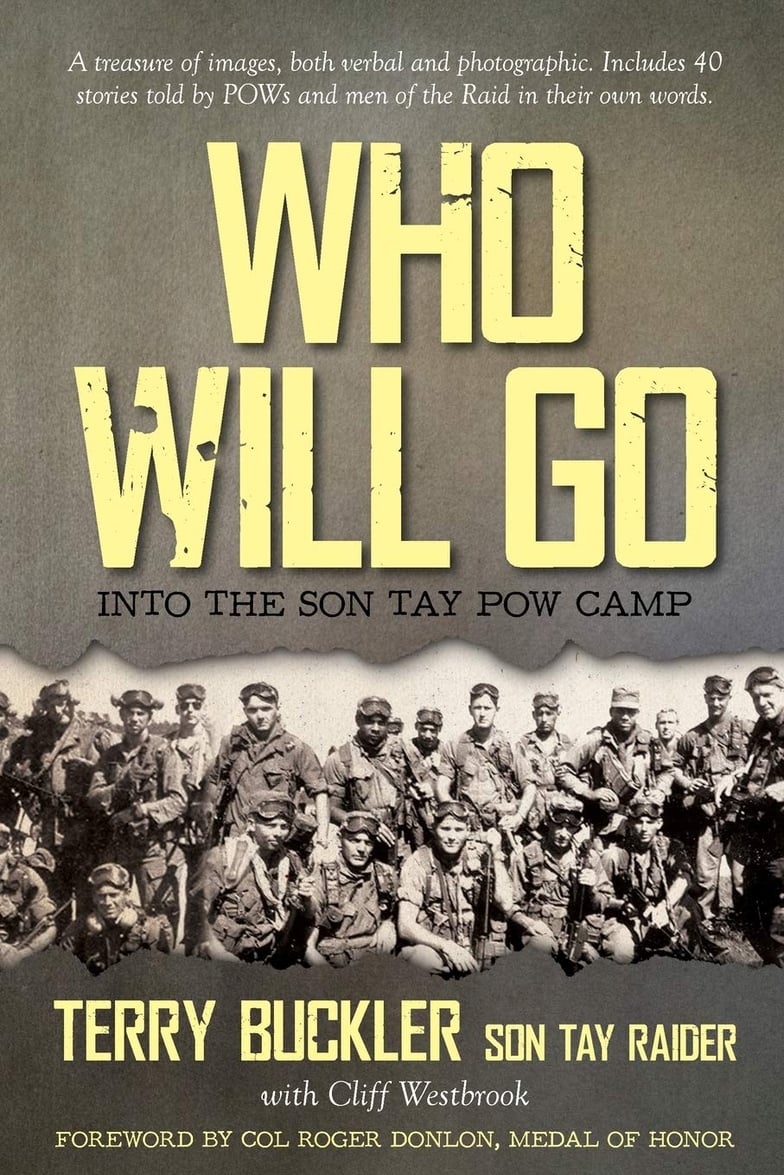
Episode Podcast 329. The Son Tay Raid. Operation Ivory Coast. With Terry Buckler. 13 avril 2022. 2h56.
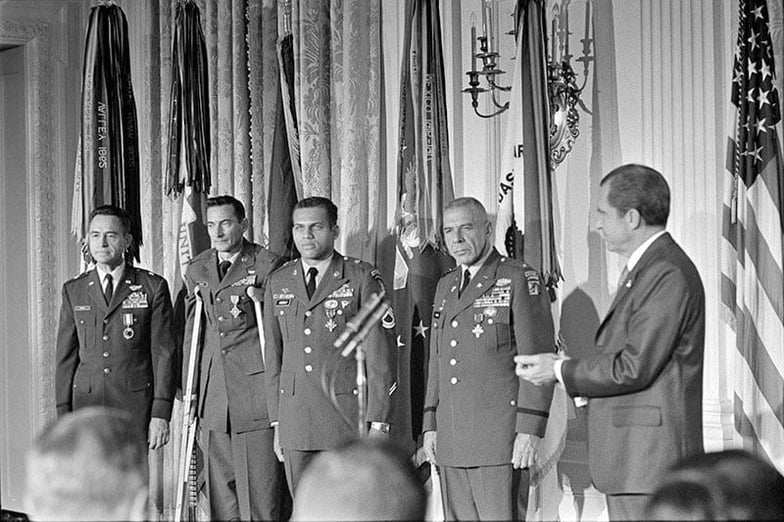
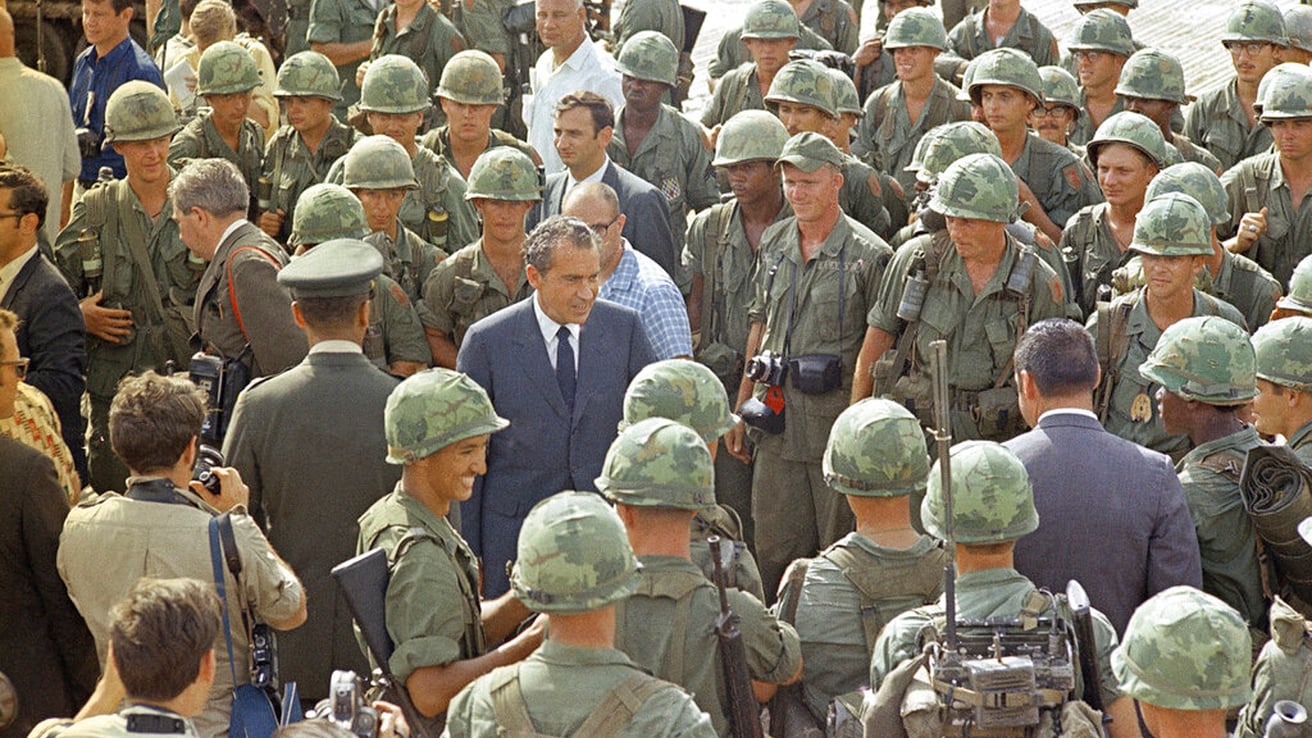
11/25/1970 President Nixon presents awards to participants in Operation Ivory Coast – the November 21st Son Tây prison camp POW rescue mission.
Col. Arthur D. “Bull” Simons and SFC Tyrone J. Adderly received the Army Distinguished Service Cross, TSgt. LeRoy M. Wright received the Air Force Cross, and Brig. Gen. Leroy J. Manor received the Air Force Distinguished Service Medal.
The mission was a tactical success even though the prisoners had previously been moved to another camp. (Image: WHPO-5150-21)
20 nov. 2017
General LeRoy J. Manor is a combat veteran of WWII and the Vietnam War. He is best known for commanding the Joint Contingency Task Group that conducted Operation IVORY COAST and KINGPIN, the special operations raid to free prisoners of war from a camp near Son Tay, North Vietnam in 1970. The joint task force successfully developed, rehearsed and executed plans in total secrecy for a direct action raid on the prison complex. General Manor established operational standards that form the basis for modern Joint Special Operations Task Forces.
President Nixon comments at the White House Ceremony honoring the Son Tay Raiders. Credit NBC Nightly News. 25 November 1970.
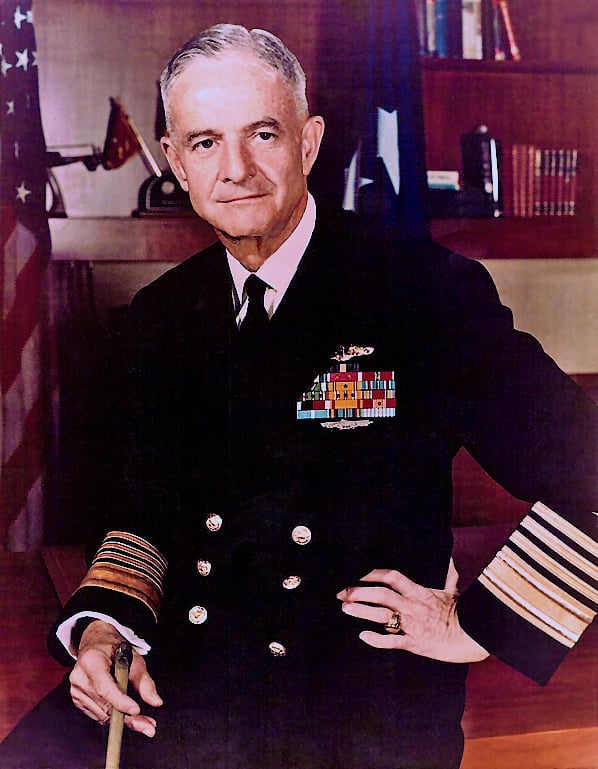
Admiral Jack McCain knew his son would likely not be among those rescued. Would he approve the Son Tay Raid, given the risk of reprisals against the remaining POWs?
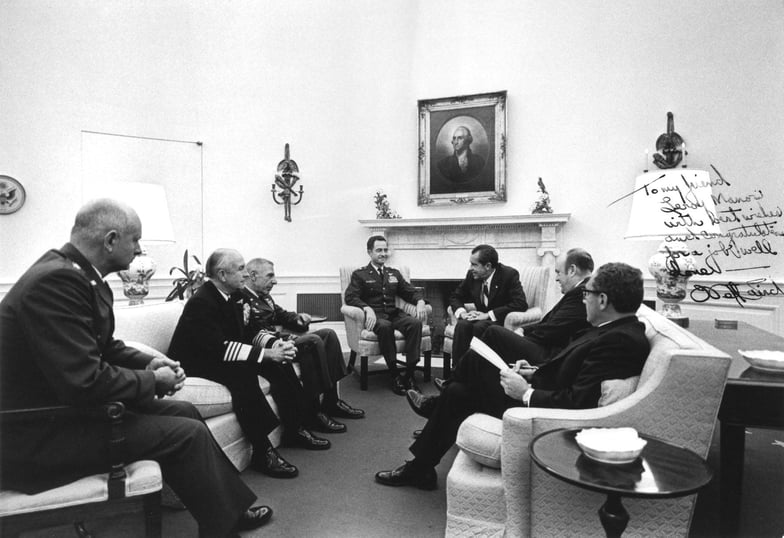
Briefing Dr Henry Kissinger. Thursday October 8th , 1970. Bull Simons, BGen Manor, and BGen Blackburn were in the White House today briefing Dr Henry Kissinger (National Security Advisor).
A lire aussi Operation Kingpin— Success or Failure? By W I L L I A M C. T H O M A S
https://apps.dtic.mil/sti/tr/pdf/ADA528536.pdf
The Raid: The Son Tay Prison Rescue Mission Hardcover – January 1, 2002
by Benjamin F. Schemmer https://www.amazon.com/Raid-Son-Prison-Rescue-Mission/dp/0739426893
https://warhistory.org/fr/@msw/article/the-raid-on-the-son-tay