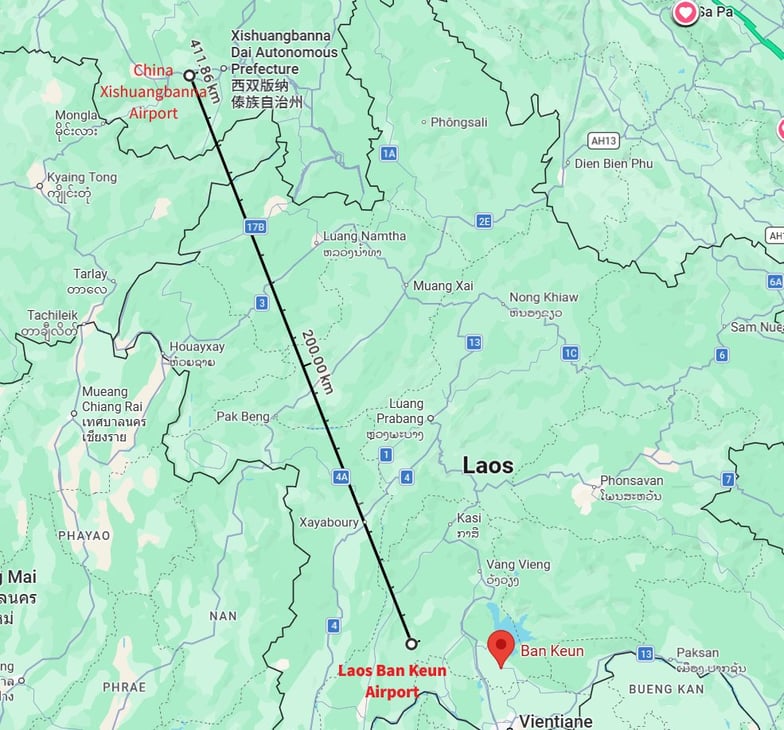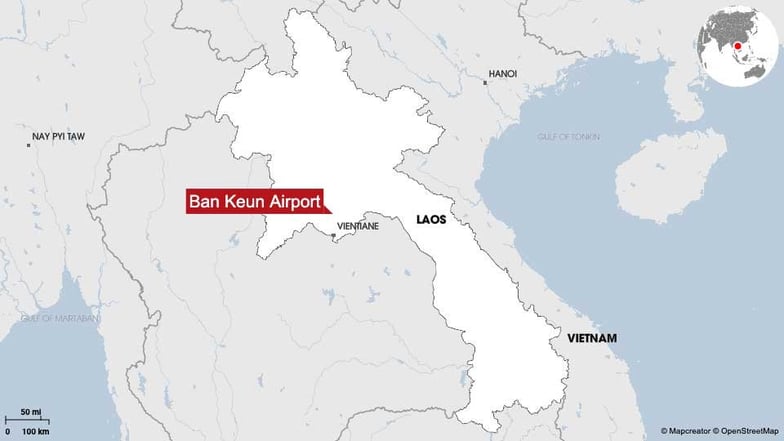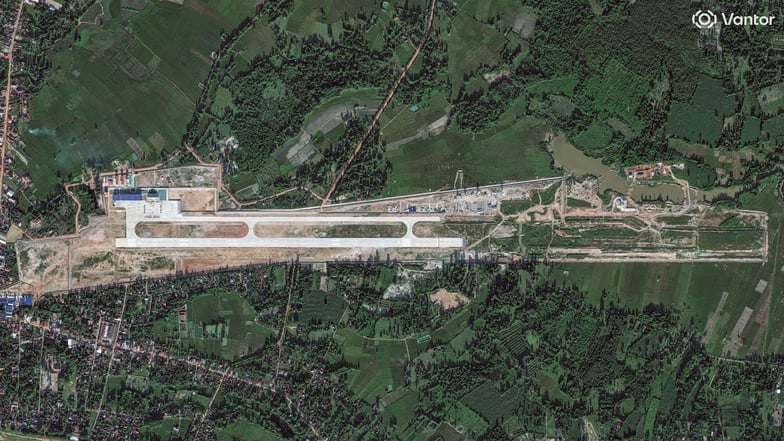

Photo de l’aéroport de Ban Keun. "If my measurements on Google Maps are correct, the runway would measure a minimum of 3,000 m long by 50 m wide." nous dit le compte Twitter T-55AM1@T_55AM1_

5:12 PM · Sep 29, 2026 · 26,1 K Vues
3 Réponses · 31 Reposts · 150 Likes
"Aéroport de Ban Keun au Laos (cliquer pour voir sa localisation) au nord de Vientiane : installation de l’Air Force Training Center chinois."
Quelques repères dans mon article, permettant de comprendre quels sont les objectifs des China-Laos Military Joint Support and Training Center installés à l'aéroport de Ban Keun, Région qui fut déjà le lieu de combats pendant la guerre d'Indochine française et le lieu de bases et d'aéroports secrets de la CIA (notamment avec Air America, compagnie aérienne de la CIA) plus ou moins rudimentaires, (Lima site 44) pendant la guerre du Vietnam. La question est de savoir si le Vietnam perd progressivement son emprise politico-militaire sur le Laos et si ce centre, officiellement destiné à former les Laotiens au pilotage et à la maintenance aéronautique, n'est pas une potentielle base stratégique avancée de l'armée chinoise. Le Vietnam ne serait-il pas encerclé au fur et à mesure et pourrait-il prétendre rester le partenaire stratégique prioritaire du Laos, en sachant que sur le plan économique, le Laos dépend tant au niveau des investissements qu’au niveau de sa dette, de la Chine, partenaire économique et financier incontournable.
Concernant les avions du type Hongdu-PAC JL-8, voir notamment ce site spécialisé. 4 appareils sur les 8 visibles sur les images satellite de l’aéroport de Ban Keun, sont censés appartenir à l'armée de l'air laotienne. Les 4 autres sont censés être chinois. La piste d'environ 2000 mètres (le compte X T-55AM1@T_55AM1_ évoque une piste de 3000 mètres) est assez longue pour accueillir des PLA fighter jets comme les Chengdu J-10 amp. Les Shenyang J-11. Les Y-20B transport aircraft. Mais elle serait trop courte @DavidGVallance pour accueillir les long-range PLA bombers comme le H-6. Toutefois, l'agrandissement de la piste permettra d'accueillir des bombardiers lourds et des avions ravitailleurs susceptibles d'accroître les rayons d'action. Idem pour les ilots de la mer de Chine, aménagés par l'armée chinoise, en base aérienne. Des comparaisons sont faites avec la base chinoise à Djibouti, mais celle-ci a été officiellement créée dans le contexte des déploiements anti-piraterie dans le golfe d'Aden (en cours depuis 2008).
Voir l'article publié le 8 octobre 2026 dans The Interpreter "What to make of China’s new air facility in Laos" de Hunter Marston.
“Attack aircraft, military vehicles visible at new China-Laos base, satellite images show”. Poppy McPherson. Greg Torode. 6 octobre 2026.
“How Chinese Analysts See Beijing’s New Aviation Center in Laos”. Rudy Lu. 3 octobre 2026.
"China Opens Air Force Training Centre in Laos at Ban Keun Airportby." Tamika Johnson. 30 septembre 2026.
"China Extends Military Reach With New Air Support Base in Laos". Josh Xiao. 29 septembre 2026. Dont extraits : "The Chinese military opened a new logistics base at an airport in Laos, expanding the People’s Liberation Army’s overseas presence. The base, the China-Laos Military Joint Support and Training Center, is intended to help Laos strengthen the training of air force pilots and will be jointly maintained by the two countries. The opening adds to the PLA’s small but growing network of overseas military facilities as China becomes more capable of projecting power beyond its borders." "China opened its first official overseas military base in Djibouti in 2017, and then the China-Cambodia Joint Support and Training Center at Cambodia’s Port Ream in 2025." "(Cambodia has highlighted that the PLA doesn’t have exclusive access to the Ream base, and foreign navy vessels from the US and Japan have visited the port.)" "Vietnam, in particular, could have “serious grounds for concern” if it becomes a foothold for a more permanent PLA presence in Laos, building on its activities at Cambodia’s Ream and in disputed areas of the South China Sea, said Nguyen Khac Giang, a visiting fellow at the ISEAS-Yusof Ishak Institute." "“These developments could give Beijing greater leverage over strategic access routes around Vietnam, raising concerns about its ability to monitor, and potentially constrain, Vietnam’s room for maneuver in time of crisis,” Giang added." "The air force facility is in Ban Keun, about 40 miles (64 kilometers) north of the capital Vientiane. The area is also home to a Cold War-era airfield known as Lima Site-44, which was used by the US for aviation and logistics operations. Satellite imagery suggests that the new center is located near that former airfield. Farmland clearing appeared to have begun around last November, according to imagery from the European Union’s Copernicus satellite program.”
Lima Site 85 : The Secret Radar the US Lost on a Mountain in Laos. Tamika Johnson. 26 septembre 2026.
Why Vietnam Should be Worried About Laos’ Economic Crisis. The country’s travails could deepen China’s influence and destabilize the longstanding alliance between Hanoi and Vientiane. Khang Vu. 22 juillet 2022.
Voici ci-dessous la reproduction de cet article, qui, datant de 2022, met en perspective, les relations politiques et économiques entre le Vietnam et le Laos.
“Laos is facing one of its worst economic crises in many years. Last month, inflation hit a 22-year high of 23.6 percent, according to official reports. Consequently, the price of fuel, gas, and gold has increased by 107.1 percent, 69.4 percent, and 68.7 percent, respectively, compared to June 2021’s price. Long lines at gas stations are no longer rare occurrences, which has, in turn, hurt the country’s recovery from the COVID-19 pandemic. The value of the local currency, the kip, has fallen from 9,300 to the U.S. dollar in September 2021 to around 15,000 today. With only $1.2 billion in foreign reserves, Laos is on the brink of sovereign bankruptcy, as the state cannot meet its debt obligations, which require it to pay $1.3 billion per year until 2025. Of Laos’ $14.5 billion in foreign debt, about half is owed to China to fund projects including the newly inaugurated $5.9 billion China-Laos railway connecting Vientiane to the Chinese border.
Against the backdrop of the crisis, Vietnam and Laos this month celebrated the 60th anniversary of the establishment of bilateral relations (1962-2022) and the 45th anniversary of the signing of the Treaty of Friendship and Cooperation (1977-2022). The leaders of both countries affirmed their “special relationship,” that Vietnam and Laos are not just neighbors but are “brothers and comrades” engaged in the joint task of national and socialist construction. Nguyen Phu Trong, the general secretary of the Vietnamese Communist Party described Vietnam-Laos ties as “invaluable” and “one of a kind” in world history. Lao Vice President Bounthong Chitmany asserted that Vientiane is determined to cultivate the “comprehensive unity of the great Vietnam-Laos relationship.”
There is no doubt that Laos is Vietnam’s most trusted friend. Indeed, Laos is the sole military treaty ally that Vietnam has had since the end of the Cold War, despite Hanoi’s official policy of nonalignment. The Vietnam-Laos Treaty of Friendship and Cooperation serves as the backbone of the alliance, under which Laos can call for military support from Vietnam when there is a threat to its security.
Since the signing of the treaty in 1977, Hanoi has considered the alliance vital to defending Vietnam from afar and denying other rivals’ influence in Laos. Such thinking is rooted in Vietnam’s geographical vulnerability. Laos borders Vietnam’s narrowest point of just 40 kilometers, which foreign enemies could exploit to cut the slender nation in half. Vietnam also understands that if China was able to control Laos, Vietnam would be surrounded by Beijing on three fronts: South China Sea in the east, China-Vietnam border in the north, and Laos and Cambodia in the west. Vietnam’s survival is thus tied to Laos’ survival. As Vietnam state media put it succinctly, “Lao security is Vietnam’s security.”
For that reason, Vietnam has gone to great lengths to ensure that Laos remains under its tutelage in the face of Chinese contestation. During the Vietnam War, despite fighting against a common U.S. enemy, Vietnamese and Chinese advisors vied for influence over Laos. After 1975, Vietnam relied on Soviet military and economic assistance to consolidate its dominance over Indochina at China’s expense. Shortly after China invaded Vietnam in February 1979, Vietnam sent troops to the Laos-China border after the Lao government reported that China had invaded a small section of its northern border. Hanoi would station more than 40,000 troops in Laos in the subsequent years in order to protect its ally from China and domestic unrest, at a time it was fighting a counterinsurgency war against the Khmer Rouge in Cambodia and preparing for another Chinese invasion along the China-Vietnam border. Throughout the 1980s, Vietnam was unquestionably Laos’ principal security and economic patron.
The end of the Cold War and the normalization of Laos-China relations in 1991 posed a new challenge to Vietnam’s dominant position in Laos, as Vientiane was more open to Chinese investments. In a low-security threat environment, the competition between Vietnam and China over Laos turned to the economic realm, forcing Laos to play a careful balancing act between its military ally Vietnam and its now most important economic partner China. Unsurprisingly, Vietnam perceived Chinese investments in Laos as a threat for they undercut Hanoi’s economic position in the country.
Since China has sought to expand its influence in Southeast Asia via the Belt and Road Initiative, Vietnam has seen its position in Laos deteriorate further. Many Lao politicians, despite getting their training in Vietnam, regard China as a favorite model of economic development. Vietnam has continued to help Laos to the best of its ability, such as gifting Laos a new national assembly house, building a new public park in Vientiane, and funding a number of cross-border infrastructure projects, such as the Hanoi-Vientiane Expressway and the Vientiane-Vung Ang Railway, a direct response to the Laos-China railway. Hanoi even sought help from Japan to build infrastructure connecting Vietnam and Laos to make up for its weaker economic power vis-à-vis China. Still, the long-term trend is clear. Vietnam is losing its grip on Laos.
To further counter China’s attempts to drive a wedge between Vietnam and Laos via economic rewards, Hanoi has stressed the defense cooperation between the two countries. It wishes to demonstrate that Vietnam is still the most important guarantor of Lao security, despite it no longer being the country’s most important economic partner. In a recent high-level meeting between the Vietnamese and Lao ministries of defense to commemorate bilateral ties, both sides affirmed that “under any circumstances, the two countries’ militaries will stand shoulder to shoulder, overcome all challenges and hardships, and protect the revolutionary accomplishments of the predecessors.”
Lao Maj.-Gen. Khamlieng Outhakaysone proclaimed that Laos will always value the “great friendship, special unity, and comprehensive cooperation” with Vietnam and believed that such strength would “push back all conspiracies dividing the two countries.” Vietnam’s Prime Minister Pham Minh Chinh again emphasized bilateral defense cooperation as an important pillar of Vietnam-Laos relations and a priority of Hanoi. Chinh added that recent economic hardships due to inflation and exorbitant fuel prices as well as an uncertain international environment should warrant closer cooperation so that both Vietnam and Laos can proactively cope with possible negativities. Vietnam’s state media noted that continued cooperation under the leadership of the two communist parties is vital to the longevity and prosperity of the Vietnamese and Lao peoples.
However, Laos’ current economic emergency may complicate Hanoi’s efforts to limit the influence of Beijing. Vietnam could only keep Laos under its wing so long as Laos maintained socio-political stability and China does not enjoy the final say in the survival of Laos’ economy, both of which are under threat due to the economic crisis. Hanoi has attempted to help alleviate some of Laos’ economic burden by increasing its investments by 33 percent between 2020 and 2021. In the first three months of 2022, bilateral trade grew 19 percent compared to the same period in 2021. Hanoi also noted that Vietnamese businesses in Laos have paid taxes worth more than $1 billion to Vientiane over the past five years. Still, it is worth remembering that no matter how much Vietnam invests in Laos, it cannot outbid China. Vietnam’s money is also not the silver bullet to Laos’ economic woes if the country cannot deal with its endemic corruption and mismanagement.
The outcome of the economic crisis may thus decide whether Laos can maintain its balancing act between Vietnam and China. In a low-security threat environment, the Lao leadership may decide that economic survival is more important than security and that the country needs economic relief from China to maintain domestic stability in the short term. In the long term, China can serve as Laos’ main security and economic guarantor if such an arrangement increases Chinese influence in Indochina at Vietnam’s expense and frees Laos of its balancing act, thereby putting an effective end to the Vietnam-Laos military alliance. Importantly, as a single-party communist state, China can also safeguard the survival of the Lao communist regime like Vietnam has been doing, which would only smooth such a transition.
As has long been the case before the COVID-19 pandemic, China’s rise has undermined Vietnam’s influence in Laos. A further weakening of the Lao party-state would only allow China to exploit its favorable power position vis-à-vis Vietnam and finally win the country to its side, after successfully doing so with Cambodia. The last time China and Vietnam fought a major ground war in 1979; it was over Cambodia. The next conflict between China and Vietnam may not be over the South China Sea but over Laos.”